CRP's “hold ranks” directive and restrictions on employee disclosures
All the President's MenThe Committee for the Re-election of the President’s “hold ranks” directive and restrictions on employee disclosures formed an informal system for containing information about Watergate. Rather than relying on one plainly stated order to lie, the committee’s response combined controlled interviews, warnings about what not to discuss, limits on contact with reporters, and pressure on employees who might know damaging facts. Hugh Sloan’s account of the message—“Hold ranks,” or “Keep the ship together”—gave the policy its defining language: loyalty was presented as organizational solidarity, while its practical effect was to narrow what investigators and the public could learn.
Structure and Methods
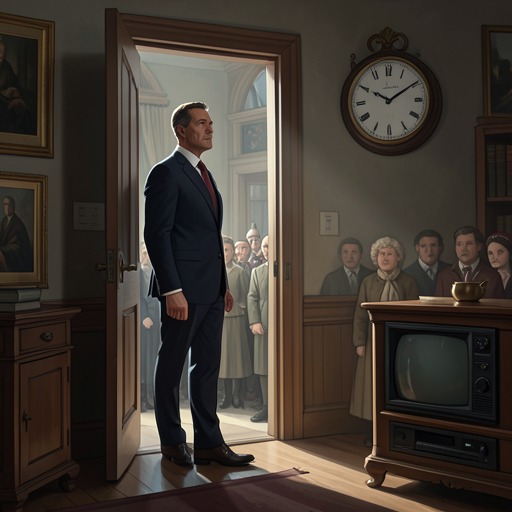
After the Watergate arrests, the committee’s internal environment made access itself a form of control. Visitors encountered a uniformed guard, had to be cleared by press or security staff, were escorted to appointments, and were led back out. Even the telephone roster of campaign officials, a single sheet listing more than one hundred names, was treated as classified. A researcher who obtained a copy from a committee contact was warned that the source could lose their job if discovered. The secrecy around ordinary staff information reinforced the broader impression that the committee functioned as an insulated organization, not an open campaign office.
The Federal Bureau of Investigation interviewed campaign personnel at committee headquarters, not at their homes. Interviews took place in the presence of committee lawyers or Robert Mardian, the committee’s political coordinator and a former Justice Department official. Some employees said that Mardian and others told them not to volunteer information unless an agent asked a specific question they could not evade, particularly on campaign finances. The arrangement did more than determine where questioning occurred: it placed employees in the presence of people connected to the committee’s response and made silence, evasion, and carefully limited answers seem institutionally expected.
The restrictions were not confined to the interview room. Employees were forbidden to speak to the press without specific clearance, even to identify their job titles. One employee said she had been followed to a lunch appointment with a reporter and questioned afterward about their conversation. Others described being told to stay away from particular subjects when speaking with the Federal Bureau of Investigation, prosecutors, or the grand jury. The reported practice was therefore both inward-facing and outward-facing: it sought to shape what investigators could obtain and to prevent employees from supplying journalists with an independent account.
Pressure, Fear, and Silence
When Bob Woodward and Carl Bernstein began visiting committee employees at home in the evenings, the reporters encountered fear before they obtained a coherent account of what had happened. One employee pleaded with Bernstein to leave before others saw him and trembled as she described the pressure she was under. Another said she wanted to help and burst into tears. These encounters did not, by themselves, establish the details of a cover-up; they did show the personal cost and apprehension surrounding attempts to speak. Some employees would talk only in fragments, and one warned the reporters not to call at work—or at home—because nobody knew what the committee might do.
The reporters’ fragmentary accounts accumulated into a pattern. Employees said that records had been destroyed after the Watergate break-in, that the Federal Bureau of Investigation had not interviewed some people in critical positions, and that staff had been cautioned about discussing finances. One account relayed the fear that if investigators saw the books, “they burned ‘em.” Another said that Sally Harmony claimed to have a bad memory and would not talk, as would G. Gordon Liddy. These were reports gathered from reluctant sources, not a single complete witness account; their force came from how the details converged around restricted testimony, missing records, and pressure to keep quiet.
The Bookkeeper, who had worked for Hugh Sloan and later for Maurice Stans, told Bernstein that she had been called before the grand jury early, but that people had already lied to it before anyone knew what questions to ask. She said that Sally Harmony and others had lied, while carefully distinguishing what she knew from what she and Harmony had discussed. She also described a small group of employees whom the committee was concerned about receiving promotions. Her account linked the problem of unreliable testimony to personnel decisions: advancement could affect the position of people who might otherwise have provided information, although the evidence does not establish that every promotion was made for that purpose.
Sloan’s Account of the Directive
Bernstein approached Sloan after a story had clarified that the former campaign treasurer was not himself guilty of Watergate. Sloan acknowledged that events were worse than the published account had suggested and said he had left because he suspected the worst. He wanted to speak, but his lawyers had advised against public statements that might be used against him in a civil suit arising from his role as treasurer. Legal exposure therefore compounded the pressure within the committee: even a person willing to tell what he knew had reason to hesitate.
Sloan confirmed that committee lawyers had been present during employee interviews. He said no one had explicitly told staff, “Don’t talk,” but that the message had been clear: “Hold ranks,” or “Keep the ship together.” Asked whether this meant lying, he said Bernstein could draw his own conclusions and that the assumption was not unreasonable. Sloan identified Mardian and Fred LaRue as the people John Mitchell had selected to develop the committee’s response to the Watergate bugging, adding that they had “engineered the response.” He said that response was not a plan to come forward and tell the truth. His careful distinction between an explicit command and an understood message describes the directive’s function: it allowed the organization to avoid stating a direct prohibition while employees could still understand what subjects and disclosures were unwelcome.
The Directive in the Wider Response
Bernstein’s draft connected Sloan’s account to a reported “massive housecleaning” after the arrests. It said records had been destroyed and staff instructed to close ranks after Mitchell selected Mardian and LaRue to direct the committee’s response. The records described in the reporting included wiretap memoranda, a single-sheet accounting of the secret fund, and as many as seven ledger books listing campaign contributors and contributions made before April 7. Robert Odle had inventoried and removed files over the weekend after the break-in, then was assigned to provide investigators with requested documents after records had been destroyed. The sequence made control over employee speech part of a broader effort to manage access to evidence, though the article’s claims and the underlying employee accounts remain distinct kinds of evidence.
Sloan confirmed virtually the entire draft when Bernstein read it to him by telephone. His account gave the otherwise diffuse warnings a recognizable formulation, while the reporters’ other sources supplied concrete examples of their operation: supervised interviews, restrictions on discussing finances, limits on press contact, reported surveillance, and sudden promotions. The rule was powerful partly because it did not need to appear as a single written command. Its language of unity could be repeated as ordinary organizational discipline even as employees understood that candor might expose them to personal and professional risk.
The pressure did not silence everyone permanently. In a later conversation, a disaffected committee official described a broader willingness to choose dishonest methods when they seemed as effective as honest ones, including spending money to manufacture support for Richard Nixon’s decision to mine Haiphong. That account concerned campaign tactics rather than the precise operation of the “hold ranks” directive, but it showed the surrounding organizational climate in which concealment and managed appearances could be treated as acceptable practice. After disclosures about payments to the Watergate conspirators, another committee official expressed disgust with the White House’s handling of the crisis and said he was sick of working for the committee. These later moments reveal a limit to enforced silence: pressure could delay disclosure, but accumulating evidence and disillusionment could turn insiders into sources.
Significance
The directive was not simply a slogan and was not described as a formal, written policy. It was a repeated message backed by control over interviews, access to information, contact with reporters, and employees’ working conditions. Sloan’s testimony is especially revealing because he neither claimed to have received a direct order to lie nor treated the absence of one as evidence that staff were free to speak. Instead, he described an understood instruction whose ambiguity helped preserve distance between the language of loyalty and the practical suppression of disclosure.
That ambiguity also shaped the investigation’s progress. Because employees spoke in pieces, often through fear or secondhand knowledge, reporters had to compare accounts and seek confirmation; meanwhile, the presence of committee representatives during interviews and the reported destruction of records limited what investigators could recover. The directive’s consequence was not total silence but a costly, uneven flow of information. Its eventual exposure depended on employees who broke from the expected discipline and on reporting that assembled their separate accounts into a picture of how the committee’s response had been managed.